

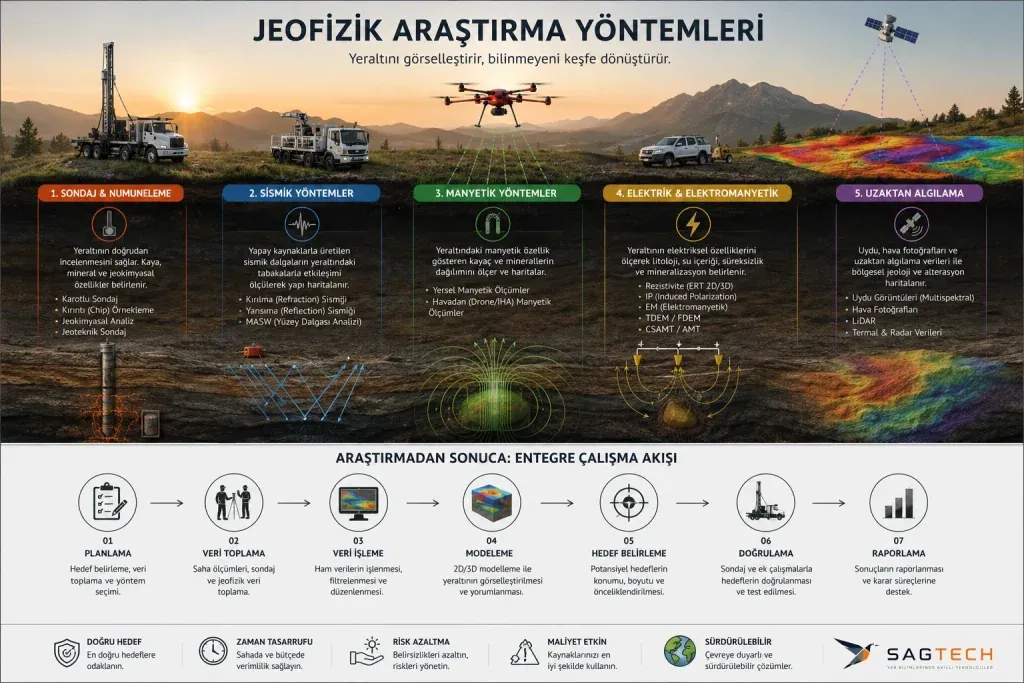
Appropriate geophysical method in mineral exploration; not only by the element sought, ore deposit type, ore minerals, bedrock, alteration, sulfur content, physical property contrast, target depth and geometry should be determined accordingly.
The tool below is based on regional exploration of different mineral and deposit types. can be used for detailed investigation and downhole verification. It was prepared to compare the main geophysical methods.
| Mine / Bed Type | Geophysical Target | Regional Search | Detail Search | In-Well / Post-Drilling |
|---|---|---|---|---|
| Au – Orogeny Gold See Technical Details ↓ | Fault and shear zones, alteration, sulfidation and mineralized vein systems | MAG UAV MAG Radiometry | IP/Resistivity, ERT, EM; CSAMT/AMT according to geological condition | Borehole IP/Resistivity, OTV/ATV, Gyro Survey, Susceptibility Logging |
Why These Methods?In orogenic gold systems, physical contrasts created by fault-shear zones, alteration, quartz veins and accompanying sulfurization are targeted instead of gold directly. The magnetic method can support the structural/lithological framework, while the IP can support polarizable sulfides. Things to ConsiderIP and magnetic response may be limited in systems with weak sulfur or low petrophysical contrast. A single anomaly should not be directly interpreted as gold mineralization. Interpretation PrincipleGeophysical anomalies alone do not mean the presence of ore or economic grade. The results should be evaluated together with geology, geochemistry, petrophysics and drilling data. Recommended research stream: Geology + structural mapping → UAV/Ground Magnetic → IP/Resistivity → CSAMT/AMT if necessary → Drilling → OTV/ATV + Gyro + downhole electrical methods | ||||
| Au-Ag – Epithermal System See Technical Details ↓ | Silicification, alteration, vein/fault systems and associated sulfides | MAG Radiometry Remote Sensing | IP/Resistivity, ERT, CSAMT, AMT | Resistivity Logging, OTV/ATV, Gamma, Gyro Survey |
Why These Methods?In epithermal systems, silicification, clay alteration, vein/fault zones and sulfurization can create different electrical and magnetic responses. Radiometry and remote sensing can help in regional monitoring of alteration zones. Things to ConsiderResistivity height alone is not an indicator of ore; Silicification, dry rock, or lithology may also respond similarly. Clay alteration may cause low resistivity. Interpretation PrincipleGeophysical anomalies alone do not mean the presence of ore or economic grade. The results should be evaluated together with geology, geochemistry, petrophysics and drilling data. Recommended research stream: Remote sensing + geology → Magnetic/Radiometry → IP/ERT → CSAMT/AMT → Drilling → Resistivity/Gamma + OTV/ATV + Gyro | ||||
| Cu-Au-Mo – Porphyria See Technical Details ↓ | Intrusive center, alteration zones, dispersed sulfur and structural control | MAG UAV MAG Gravity Radiometry | IP/Resistivity, ERT, MT/AMT/CSAMT | Borehole IP, Susceptibility, Density, Resistivity, OTV/ATV, gyro |
Why These Methods?Porphyry systems contain large-scale intrusive centers, zoned alteration, and disseminated sulphide mineralization. Magnetic and gravity system geometry; IP dispersed sulphides; MT/AMT/CSAMT can be used to define the deep resistivity structure. Things to ConsiderThe magnetic response may change as magnetite forms or disappears during alteration. Strong IP anomalies alone do not prove economic Cu-Au-Mo grade. Interpretation PrincipleGeophysical anomalies alone do not mean the presence of ore or economic grade. The results should be evaluated together with geology, geochemistry, petrophysics and drilling data. Recommended research stream: Geology + remote sensing → UAV/Regional MAG + Gravity/Radiometry → IP/Resistivity → MT/AMT/CSAMT → 3D integration → Drilling → Borehole IP + Density + Susceptibility + Gyro | ||||
| Cu-Zn-Pb-Au-Ag – VMS See Technical Details ↓ | Massive or semi-massive conductive sulfur bodies, feeder zones and alteration | MAG Airborne EM | TDEM, FDEM, IP/Resistivity, gravity | Borehole EM, Borehole IP, Resistivity, Density, susceptibility |
Why These Methods?In VMS deposits, massive or semi-massive sulphide bodies can be electrically conductive and dense. This is why EM methods are particularly powerful; IP, gravity and magnetic can be complementary. Things to ConsiderSome major ore minerals, such as sphalerite, can be poor conductors. Graphitic zones or conductive schists may create VMS-like EM anomalies. Interpretation PrincipleGeophysical anomalies alone do not mean the presence of ore or economic grade. The results should be evaluated together with geology, geochemistry, petrophysics and drilling data. Recommended research stream: Geology → Airborne/UAV MAG + Airborne EM → TDEM/FDEM → IP/Resistivity + Gravity → Drilling → Borehole EM + Borehole IP + Density | ||||
| Pb-Zn-Ag – SEDEX See Technical Details ↓ | Stratiform sulfurous levels, basin structure and mineralized horizons | MAG Gravity EM | TDEM/FDEM, IP/Resistivity, ERT | Borehole EM, Borehole IP, Gamma, Density |
Why These Methods?SEDEX deposits show stratiform sulphide levels and basin-controlled geometry. EM and IP mineralized levels; gravity and magnetics may support the basin/lithology framework. Things to ConsiderEM response may be weakened if sulfide mineralogy and bed thickness are low. Graphitic or saline levels in the basin may produce conductive anomalies. Interpretation PrincipleGeophysical anomalies alone do not mean the presence of ore or economic grade. The results should be evaluated together with geology, geochemistry, petrophysics and drilling data. Recommended research stream: Basin geology → Regional MAG/Gravity/EM → TDEM/FDEM + IP/ERT → target modeling → Drilling → Borehole EM/IP + Gamma + Density | ||||
| Pb-Zn–MVT See Technical Details ↓ | Ore zones in carbonate rocks, structural control and dolomitization | Gravity MAG Regional EM | IP/Resistivity, ERT, EM – conditional | Resistivity, Gamma, Density, OTV/ATV |
Why These Methods?MVT systems are structural/stratigraphically controlled Pb-Zn sulfide zones in carbonate rocks. Since electrical contrast is variable, IP/ERT and EM are often evaluated in conjunction with the geological framework. Things to ConsiderThe geophysical signature of MVT deposits is very variable; Direct detection may be difficult due to low sulfur content or poor contrast. Interpretation PrincipleGeophysical anomalies alone do not mean the presence of ore or economic grade. The results should be evaluated together with geology, geochemistry, petrophysics and drilling data. Recommended research stream: Carbonate geology + structural analysis → Gravity/MAG → IP/ERT → conditional EM → Drilling → Resistivity/Gamma/Density + OTV/ATV | ||||
| Cu – Sediment-Hosted / Stratiform Copper See Technical Details ↓ | Redox boundaries, conductive stratigraphic levels and sulfide mineralization | MAG Gravity EM | IP/Resistivity, TDEM/FDEM, ERT | Borehole IP, Borehole EM, Resistivity |
Why These Methods?Sediment-hosted copper systems target redox boundaries, permeable stratigraphic levels and sulfide zones. EM and IP electrical properties; gravity/magnetic supports basin and structural control. Things to ConsiderConductive shale, graphite or saline fluids can create non-mineralization anomalies. The element itself is not measured directly. Interpretation PrincipleGeophysical anomalies alone do not mean the presence of ore or economic grade. The results should be evaluated together with geology, geochemistry, petrophysics and drilling data. Recommended research stream: Basin model → MAG/Gravity/EM → IP/Resistivity + TDEM/FDEM → Drilling → Borehole IP/EM + Resistivity | ||||
| Fe-Cu-Au-Co – IOCG See Technical Details ↓ | Iron oxide enrichment, structural zones and Cu-Au-Co mineralization | MAG Gravity Radiometry | IP/Resistivity, EM, ERT | Susceptibility, Density, Gamma, Borehole EM/IP, gyro |
Why These Methods?IOCG systems may be marked by iron oxide enrichment, high density, and variable magnetic properties. In gravity and magnetic regional targeting; IP/EM can be used in accompanying sulfur zones. Things to ConsiderHematite-dominated systems may be magnetically weak. Radiometry does not directly measure Co or Cu; only helpful for associated lithology/alteration. Interpretation PrincipleGeophysical anomalies alone do not mean the presence of ore or economic grade. The results should be evaluated together with geology, geochemistry, petrophysics and drilling data. Recommended research stream: Regional MAG + Gravity + Radiometry → Detail MAG/Gravity → IP/EM/ERT → Drilling → Density + Susceptibility + Gamma + Borehole EM/IP + Gyro | ||||
| Ni-Cu-PGE – Igneous Sulfur See Technical Details ↓ | Mafic-ultramafic intrusions and conductive Ni-Cu sulphide masses | MAG UAV MAG Gravity | TDEM/FDEM, IP, Detail Magnetic | Borehole EM, Susceptibility, Density, gyro |
Why These Methods?The main goal is to map mafic-ultramafic intrusions and identify conductive massive sulfides in magmatic Ni-Cu-PGE deposits. EM is therefore critically important. Things to ConsiderNon-conductive scattered sulphides can be faintly seen by EM. Graphitic units can produce strong false positives. Interpretation PrincipleGeophysical anomalies alone do not mean the presence of ore or economic grade. The results should be evaluated together with geology, geochemistry, petrophysics and drilling data. Recommended research stream: Regional/UAV MAG + Gravity → TDEM/FDEM → Detail EM + IP → Drilling → Borehole EM + Density + Susceptibility + Gyro | ||||
| PGE – Platinum Group Elements See Technical Details ↓ | Ultramafic units, chromite horizons and Ni-Cu sulfides | MAG Gravity | TDEM/FDEM, IP/Resistivity | Borehole EM, Susceptibility, Density |
Why These Methods?PGE is most often associated with ultramafic/mafic complexes, chromite horizons or Ni-Cu sulfides. Magnetic and gravity main complex; EM/IP, on the other hand, targets sulfur compounds. Things to ConsiderPGE elements are not directly measured geophysically. The EM/IP response may be limited in sulfide-free PGE mineralization. Interpretation PrincipleGeophysical anomalies alone do not mean the presence of ore or economic grade. The results should be evaluated together with geology, geochemistry, petrophysics and drilling data. Recommended research stream: Geology + MAG/Gravity → EM/IP by target → Drilling → Borehole EM + Density + Susceptibility | ||||
| Cr – Podiform Chromite See Technical Details ↓ | Dense chromite lenses in the ophiolite, dunite/peridotite zones | MAG Gravity Geological Mapping | Detail Gravity, Detail Magnetic | Density, Susceptibility, Gyro Survey |
Why These Methods?Podiform chromite lenses can create density contrast within ophiolitic peridotite/dunite. The magnetic method often maps ultramafic geology, serpentinization, and associated magnetite distribution rather than the chromite itself. Things to ConsiderMagnetic anomaly does not directly mean chromite. Serpentinized ultramafics and magnetite-rich zones can produce strong magnetic anomalies. Interpretation PrincipleGeophysical anomalies alone do not mean the presence of ore or economic grade. The results should be evaluated together with geology, geochemistry, petrophysics and drilling data. Recommended research stream: Geological mapping → UAV/Ground Magnetic + Gravity → Detail Gravity/Magnetic → Drilling → Density + Susceptibility + Gyro Survey | ||||
| Cr-PGE – Stratiform Chromite See Technical Details ↓ | In layered mafic-ultramafic complexes chromite and PGE horizons | MAG Gravity | Detail Gravity, MAG, EM/IP – if sulfur is present | Density, Susceptibility, Borehole EM, gyro |
Why These Methods?Stratiform chromite may show continuity in layered mafic-ultramafic complexes. Gravity and magnetic complex geometry; EM/IP, on the other hand, can support mineralized horizons if associated sulfur is present. Things to ConsiderEM is not directly sensitive to chromite; It makes sense mainly when accompanied by conductive sulfur. Interpretation PrincipleGeophysical anomalies alone do not mean the presence of ore or economic grade. The results should be evaluated together with geology, geochemistry, petrophysics and drilling data. Recommended research stream: Regional MAG + Gravity → Detail MAG/Gravity → EM/IP if sulfur is present → Drilling → Density + Susceptibility + Borehole EM + Gyro | ||||
| Fe-Ti – Magnetite / Ilmenite Oxide Deposits See Technical Details ↓ | High density Fe-Ti oxide lenses and ore zones containing magnetite | MAG Gravity | Detail Magnetic, Detail Gravity | Density, Susceptibility, gyro |
Why These Methods?Magnetite strong magnetic susceptibility; Fe-Ti oxide masses can often show high density. Therefore, magnetic and gravity can provide direct petrophysical targets. Things to ConsiderThe magnetic response of ilmenite-dominated ores may not be as strong as magnetite. Remanent magnetization can complicate interpretation. Interpretation PrincipleGeophysical anomalies alone do not indicate the presence of ore or economic grade. The results should be evaluated together with geology, geochemistry, petrophysics and drilling data. Recommended research stream: Regional/UAV MAG → Gravity → Detail MAG/Gravity → 3D modeling → Drilling → Density + Susceptibility + Gyro | ||||
| Fe – Banded Iron Formation (BIF) See Technical Details ↓ | Ferrous stratigraphic levels containing magnetite/hematite | MAG Gravity | Detail MAG, Gravity, ERT – conditional | Susceptibility, Density, gamma |
Why These Methods?BIF units can give strong magnetic and density contrasts depending on the magnetite/hematite ratio. Continuity and thickness can be monitored in regional magnetic data. Things to ConsiderHematite-dominated BIF may be magnetically weaker. Magnetic anomaly alone does not indicate ore quality. Interpretation PrincipleGeophysical anomalies alone do not mean the presence of ore or economic grade. The results should be evaluated together with geology, geochemistry, petrophysics and drilling data. Recommended research stream: Regional MAG + Gravity → Detail MAG/Gravity → structural modeling → Drilling → Density + Susceptibility + Gamma | ||||
| Mn – Manganese See Technical Details ↓ | Mn oxide/carbonate zones, stratigraphy and associated geological boundaries | MAG Gravity Remote Sensing | ERT, IP, EM – dependent on mineralogical condition | Density, Gamma, Resistivity |
Why These Methods?The physical properties of manganese deposits vary widely depending on their mineralogy. Gravity, magnetic and electrical methods mostly target stratigraphy and bedrock contrasts. Things to ConsiderThere is no single, universal geophysical method for Mn mineralization. Mineralogical/petrophysical tests can be critical in method selection. Interpretation PrincipleGeophysical anomalies alone do not mean the presence of ore or economic grade. The results should be evaluated together with geology, geochemistry, petrophysics and drilling data. Recommended research stream: Geology + remote sensing → MAG/Gravity → ERT/IP/EM by petrophysics → Drilling → Density + Gamma + Resistivity | ||||
| Ni-Co – Laterite See Technical Details ↓ | Lateritic profile thickness, saprolite/limonite zones and ultramafic bedrock | MAG Remote Sensing | ERT, TEM, EM, Gravity if necessary | Gamma, Resistivity, Density |
Why These Methods?Lateritic Ni-Co is not the main geophysical target element in searches; limonite-saprolite profile thickness, ultramafic host rock and moisture/conductivity changes. Things to ConsiderClay and water content strongly affect electrical methods. Electrical anomaly does not directly imply Ni-Co grade. Interpretation PrincipleGeophysical anomalies alone do not indicate the presence of ore or economic grade. The results should be evaluated together with geology, geochemistry, petrophysics and drilling data. Recommended research stream: Geology + Remote Sensing + MAG → ERT/TEM/EM → profile modeling → Drilling → Gamma + Resistivity + Density | ||||
| REE-Nb – Carbonatite See Technical Details ↓ | Carbonatite/alkaline intrusion complex, density, magnetic and radiometric contrasts | MAG Gravity Radiometry | Detail MAG/Gravity, ERT/IP/EM – depending on bed specifications | Gamma, Density, Susceptibility, OTV/ATV |
Why These Methods?Carbonatite and alkaline complexes may differ from surrounding rocks in terms of density, magnetic properties and U-Th-K content. Therefore, gravity, magnetics and radiometry are valuable together. Things to ConsiderRadiometry does not directly measure REE. The petrophysical properties and cover thickness of carbonatite vary from site to site. Interpretation PrincipleGeophysical anomalies alone do not indicate the presence of ore or economic grade. The results should be evaluated together with geology, geochemistry, petrophysics and drilling data. Recommended research stream: Regional MAG + Gravity + Radiometry → Detail MAG/Gravity → depending on condition ERT/IP/EM → Drilling → Gamma + Density + Susceptibility + OTV/ATV | ||||
| Li–LCT Pegmatite See Technical Details ↓ | Pegmatite veins, bedrock boundaries and structural control | MAG Radiometry Remote Sensing | ERT, EM, GPR – on suitable grounds | Gamma, Resistivity, OTV |
Why These Methods?In LCT pegmatites, the geophysical target is not lithium itself; The geometry of pegmatite veins, their petrophysical contrast with the host rock, and their structural control. Things to ConsiderIf there is not sufficient contrast between the pegmatite and the host rock, the discrimination of magnetic/electric methods may decrease. GPR can only be used in suitable and resistant shallow ground. Interpretation PrincipleGeophysical anomalies alone do not indicate the presence of ore or economic grade. The results should be evaluated together with geology, geochemistry, petrophysics and drilling data. Recommended research stream: Geology + Remote Sensing → MAG/Radiometry → ERT/EM → GPR under suitable conditions → Drilling → Gamma + Resistivity + OTV | ||||
| Li – Brine / Saline Aquifer See Technical Details ↓ | Highly conductive saline aquifers, basin geometry and permeable zones | Gravity TEM MT | TEM/TDEM, ERT, MT/AMT | EC, Resistivity, temperature, flow meter |
Why These Methods?Low resistivity/high conductivity due to high salinity in brine systems is a strong geophysical target. TEM and MT can describe basin and conductive fluid geometry. Things to ConsiderGeophysical methods do not directly determine Li concentration; Other saline fluids can also produce the same conductivity signature. Interpretation PrincipleGeophysical anomalies alone do not indicate the presence of ore or economic grade. The results should be evaluated together with geology, geochemistry, petrophysics and drilling data. Recommended research stream: Basin geology + Gravity → TEM/TDEM + MT/AMT → ERT detail → Drilling → EC + Resistivity + Temperature + Flowmeter | ||||
| U – Sandstone Type Uranium See Technical Details ↓ | Radioactive mineralization, redox boundaries and permeable stratigraphic levels | Radiometry MAG EM | Gamma Spectrometry, ERT/IP, E.M. | Natural Gamma, Spectral Gamma, Resistivity, SP |
Why These Methods?Since uranium mineralization is radioactive, gamma spectrometry and well gamma logs can be directly useful. EM/ERT, on the other hand, supports permeable levels and a redox-controlled hydrogeological environment. Things to ConsiderSurface radiometry is affected by cover thickness and humidity. Radioactive anomaly does not by itself prove an economic uranium deposit. Interpretation PrincipleGeophysical anomalies alone do not mean the presence of ore or economic grade. The results should be evaluated together with geology, geochemistry, petrophysics and drilling data. Recommended research stream: Regional Radiometry + geology → MAG/EM → ERT/IP → Drilling → Natural/Spectral Gamma + Resistivity + SP | ||||
| C – Graphite See Technical Details ↓ | electrically conductive and polarizable graphitic zones | EM MAG | TDEM/FDEM, IP/Resistivity | Borehole EM, Resistivity, IP |
Why These Methods?Graphite can exhibit high electrical conductivity and polarizable behavior. Therefore, EM and IP methods are powerful targeting tools. Things to ConsiderGraphite can produce similar EM/IP anomalies as VMS and other sulfur targets. A distinction must be made with geology, magnetics and gravity. Interpretation PrincipleGeophysical anomalies alone do not mean the presence of ore or economic grade. The results should be evaluated together with geology, geochemistry, petrophysics and drilling data. Recommended research stream: Geology → EM + MAG → TDEM/FDEM + IP/Resistivity → Drilling → Borehole EM + Resistivity/IP | ||||
| coal See Technical Details ↓ | Geometry of coal seams, basin structure, vein thickness and cover | Seismic Gravity | Seismic Reflection, ERT/Resistivity, E.M. | Density, Natural Gamma, sonic, Resistivity |
Why These Methods?The target in coal exploration is seam thickness, continuity, basin geometry and cover structure. Seismic reflection is especially important in imaging the geometry of layered systems. Things to ConsiderThe electrical response of a coal seam varies with moisture, ash content, and surrounding rocks. A single method is not sufficient in all fields. Interpretation PrincipleGeophysical anomalies alone do not mean the presence of ore or economic grade. The results should be evaluated together with geology, geochemistry, petrophysics and drilling data. Recommended research stream: Basin geology + Gravity → Seismic Reflection → ERT/Resistivity/EM → Drilling → Density + Natural Gamma + Sonic + Resistivity | ||||