

FIELD MEASUREMENT AND ANALYSIS
Trace vibration from its source to the equipment
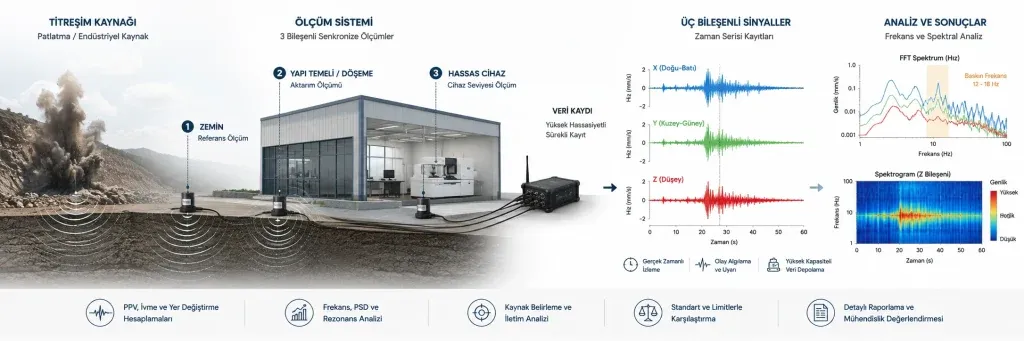
Blasting, machinery, traffic and construction can transmit vibration through the ground and structures. Three-component sensors record its amplitude, direction, duration and frequency so that the response at each measurement point can be compared.
01 / APPLICATIONS
Where is vibration measured?
Blasting
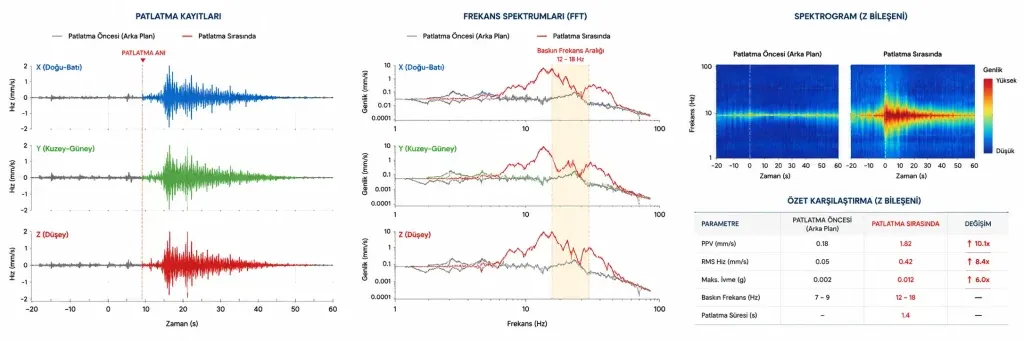
Record ground and structure response near mines, quarries and controlled blasting sites. Compare the event with ambient conditions measured beforehand.
Sensitive equipment
Assess vibration at microscopes, precision balances, calibration systems and other sensitive equipment against available manufacturer criteria.
Industrial facilities
Investigate vibration from motors, pumps, compressors, presses and production lines at several synchronised points.
Construction
Monitor the effects of piling, breaking, excavation and heavy machinery before, during and after work.
02 / MEASUREMENT
Microtremor and baseline conditions
Microtremor measurements record the low-amplitude natural and human-made motion that is continuously present at a site. A baseline taken before blasting or another event helps distinguish the event response from normal operating conditions.
Depending on the objective, synchronised sensors can be placed outside, on the foundation and floor, and near sensitive equipment. Spectral and HVSR analyses can also be used to investigate dominant frequency behaviour where appropriate.
03 / DATA ANALYSIS
Read both amplitude and frequency
Velocity, acceleration and displacement time series can be assessed with PPV, RMS, FFT, power spectral density and spectrograms. The method and sensor are selected for the expected frequency range, sensitivity and sampling needs.
04 / INSTRUMENTS
Select sensors for the project
Frequency range, sensitivity, dynamic range and sampling rate determine which instrument is suitable. Multiple sensor types may be combined when measuring ground, structure and equipment response.
Three-component geophones
Record ground and structure motion along three axes.
Broadband seismometers
Capture low-level motion across a wider frequency range.
Sensitive accelerometers
Measure acceleration at equipment, machines and structures.
Continuous recorders
Support long-term or event-triggered vibration monitoring.
05 / WORKFLOW AND REPORTING
From baseline to impact assessment
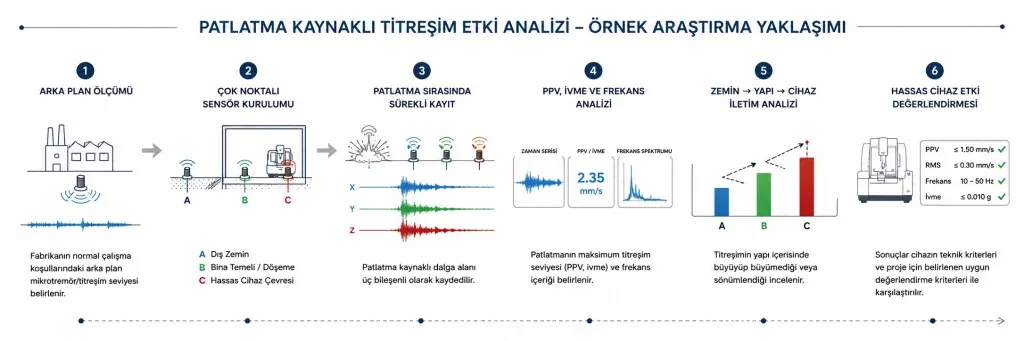
- Measure ambient vibration before the event
- Install synchronised sensors on ground, foundation, floor and near the equipment
- Record three-component signals continuously during the event
- Compare PPV, acceleration, RMS and frequency content
- Evaluate amplification or attenuation from ground to equipment
- Report findings against relevant project and equipment criteria
Reports may include three-component records, PPV and RMS values, frequency spectra, spectrograms, baseline comparisons and transmission between measurement points. Equipment limits are considered only when the relevant manufacturer criteria are available.